
The Forgotten Social Contract: Why Britain Needs a New Settlement
A Quiet Unravelling of Trust, Duty, and National Purpose.

I. What Held Britain Together
There was once a time when British society operated on a shared understanding — not written down, not codified, but deeply felt. You worked, and you earned. You paid in, and you took out when needed. You respected institutions, and they served you in return. It was never perfect, but it was coherent. The rules made sense.
That understanding is breaking down. Across the country, trust in institutions is collapsing. Faith in fairness is eroding. People no longer believe that effort is rewarded, that rules are applied equally, or that the country works for people like them. And the data bears this out. Productivity has stalled. Social mobility has slowed. A record number of people are neither in work nor looking for it. A quiet disengagement is underway.
This isn’t a condemnation of those who are genuinely unwell or unable to work — society has a duty to protect the vulnerable. But too many people have quietly withdrawn not out of necessity, but disinterest. We’ve lost the sense that contribution, in any form, is part of the social fabric.
Subscribe to The Third Island for serious, fact-based commentary on Britain’s future.
II. Not Just Economics — A Loss of Cohesion
This is not just about economics. It’s about cohesion — the sense that Britain is more than just a collection of individuals or interest groups. When people stop believing the system is fair, they stop investing in it emotionally. They pay their taxes with resentment. They see the law as something to navigate, not respect. They view the government as a machine for others — not for them.
III. The Old Contract: Duty in Exchange for Support
The post-war settlement — a promise of cradle-to-grave care in exchange for responsibility and contribution — was never formally declared, but it held the country together. Of course, the old contract wasn’t perfect — not everyone was equally included. But it gave the country a centre of gravity, a shared set of expectations. That sense of orientation has vanished.
Today, the state is overstretched. Services are crumbling. The NHS is no longer reliably there when you need it. Schools are under pressure. Councils are going bankrupt. And the people being asked to fund it all — the working-age middle — are quietly losing faith.
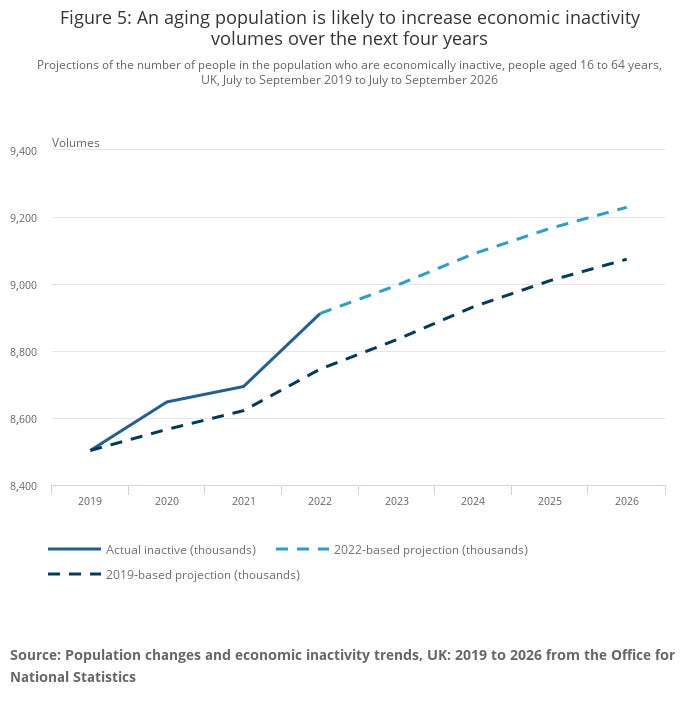
Figure 5: Economic inactivity among working-age adults has steadily risen — and is projected to rise further as the population ages. Source: ONS – Economic Inactivity Trends
IV. Denial at the Top, Disengagement Below
What makes this moment dangerous is that no one is being honest about it. Politicians pretend the current model can be patched up. That all we need is more money, more efficiency, more growth. But the truth is simpler and harder: the system is doing exactly what it was designed to do — for a country that no longer exists.
Britain is older. More indebted. Less productive. And still trying to run a 20th-century settlement in a 21st-century reality. The result is a quiet disillusionment — not the dramatic kind that fills streets, but the slower kind that empties ballot boxes, hollows out trust, and corrodes national purpose.
V. What a New Contract Could Mean
A new social contract is not about abandoning the vulnerable or glorifying austerity. It’s about rebuilding something fair, honest, and sustainable. A system where contribution is recognised, where responsibility is expected, and where the state focuses on what it can do well — not what it can no longer afford to do badly.
It wouldn’t begin with spending plans — it would begin with trust. People need to believe that their effort means something. That rules apply equally. That the country still stands for something they can belong to.
VI. A Conversation We Must Have
Britain doesn’t need slogans. It needs a grown-up conversation. One that begins with a simple, serious question:
What should we expect from each other — and what should we be willing to give?
The old contract is broken.
It’s time to write a new one.
Enjoying The Third Island? Subscribe to get new posts direct to your inbox.