
The Quiet Unravelling of Brexit
Starmer’s EU deal hands back control over fishing and regulation — without a vote, without scrutiny, and without a single word in the manifesto.

I. The Price We Paid — and the Quiet Return
Britain paid £39 billion to leave the EU. We fought through years of delay, division and political chaos to take back control.
Now, control is being handed back — without a Parliamentary vote, without scrutiny, and without a single line in Labour’s manifesto. Fishing access. Regulatory alignment. Quiet surrender, marketed as maturity.
This is how Brexit unravels: not in Parliament, but behind closed doors.
Subscribe to The Third Island for serious, fact-based commentary on Britain’s future.
II. What They’re Not Telling You About the EU Reset
This isn’t a symbolic gesture. Starmer’s “reset” with the EU involves real, measurable concessions — starting with fishing. The four-year transitional arrangement under the 2020 Trade and Cooperation Agreement has now expired. Instead of reclaiming full control of British waters, the UK is renewing access for EU vessels — offering up what was once billed as a red line.
It doesn’t end there. Britain is also re-aligning with EU rules on product standards, environmental regulation, and labour law — including frameworks like REACH (chemicals), CE conformity, and energy directives. These aren’t tweaks. They are strategic shifts — restoring Brussels’ influence over UK law, but without any British input.
None of this has been debated in Parliament. There’s been no vote, no scrutiny, and no mandate from the public. Starmer promised to “make Brexit work.” This looks more like the first stage of undoing it — one framework at a time, quietly and deliberately.
It’s clear who benefits: large exporters, legal firms, compliance consultancies — the post-Brexit winners. But the losers are once again coastal towns, independent fishermen, and working communities that were promised renewal.
They’ve been bypassed — again.
And this is only stage one. If this trajectory goes unchallenged, deeper concessions will follow — not through open debate, but by design.
III. This Isn’t Drift — It’s Design
This isn’t drift. It’s design. Starmer’s deal with the EU isn’t a one-off; it’s the first step in a longer recalibration. The method is quiet, procedural, and calculated — just like the man himself.
No big speeches. No direct challenge to Brexit. Just a slow, deliberate reattachment to the EU’s legal and regulatory orbit.
It fits his instincts. Starmer was a prominent Remainer. He backed a second referendum. He served as Shadow Brexit Secretary under Jeremy Corbyn and pushed for closer alignment with Brussels at every turn.
Now, as Prime Minister, he’s doing what many suspect he always intended: managing Brexit as a problem to be corrected, not a mandate to be fulfilled.
The style is unmistakably technocratic — negotiations behind closed doors, framed as “mature governance,” sold as “sensible progress.”
But it’s more than that. It’s a shift in power, strategy, and sovereignty — made without consent.
And it speaks to something bigger: a political culture in which voters are consulted rarely, and only when convenient.
Where sovereignty is not defended, but traded away by people who think they know best.
Subscribe to The Third Island for serious, fact-based commentary on Britain’s future.
IV. Where This Really Leads
If this reset goes unchallenged, Britain risks being drawn back into the EU’s regulatory orbit — not through rejoining, but through quiet absorption. No seat at the table. No formal influence. Just rules made in Brussels — applied in Britain.
Legal independence will weaken. Sovereignty will become symbolic.
And each concession sets precedent. Once access is granted, it becomes expected. Future governments will find it easier to give more ground under the guise of “technical cooperation.”
Financial services. Defence coordination. Migration policy. All could return to the table — inch by inch.
Britain sleepwalked into Maastricht. This time, it’s happening in reverse.
And the impact won’t be felt evenly. Towns like Grimsby, Brixham, and Fraserburgh — once promised revival — will feel the sting of betrayal.
So might British farmers if agri-standards tilt against them. Or small manufacturers if compliance costs return via the back door.
The anger won’t fade. It will deepen.
And if voters continue to watch constitutional decisions unfold without vote or debate, something deeper will break: trust.
And when trust breaks, the response won’t come from the centre.
The quieter this reversal is, the louder the reaction may be.
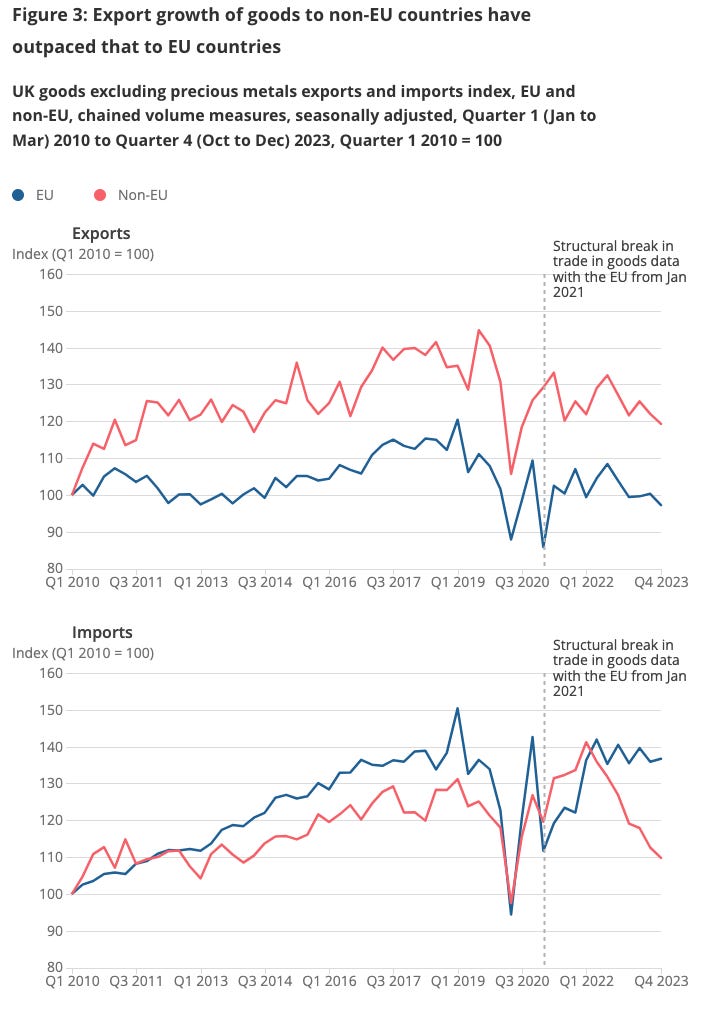
Since Brexit, UK export growth to non-EU countries has outpaced that to the EU, while imports from the EU have sharply declined. Source: Office for National Statistics – UK Trade: December 2023
V. The Fragile Thread of Trust
Trust is the real casualty. And once it’s gone, it rarely comes back.
Britain is not just approaching that threshold — in many places, we’ve already crossed it.
Starmer’s EU deal is part of a wider pattern: politicians making far-reaching decisions without consent, explanation, or accountability. As if democracy is optional. As if sovereignty is just a slogan.
And the public feels it. In the Red Wall. In coastal towns. Across the country.
People feel bypassed, patronised, and used. And they’re right to.
Real trust requires real permission. Real accountability. Real debate. None of that is happening now.
Both parties are to blame. Labour is executing the reset. But the Conservatives enabled the drift. Neither has stood up for the spirit of Brexit.
Neither has treated sovereignty as a cause worth defending — only managing.
Politics now feels performative. Leaders chase headlines, trade deals, and praise from Davos — while voters are treated as an afterthought.
And when trust collapses, people don’t simply switch off. They look elsewhere.
And what they find there may not be centrist. Or even democratic.
This isn’t just a Brexit story. It’s a Britain story.
And Westminster is still pretending not to see it.
VI. The Question That Now Matters Most
The question now isn’t just whether Brexit is being undone.
It’s whether Britain is still governed by the people who live in it.
Enjoying The Third Island? Subscribe to get new posts direct to your inbox.